How Often Does a Commercial Site Need Grounds Maintenance?
Choosing a service frequency for commercial and industrial sites, and what deferred grounds maintenance actually costs when it is left too long.
The honest answer is that it depends on the site, but not in the vague way that usually means someone does not want to give you a number. It depends on four things you can actually assess, and once you have, the frequency is fairly obvious.
This article covers how to set a schedule, and what it costs when you do not.
The four things that set frequency
Growth rate. In South East Queensland this is seasonal and dramatic. Open grass through a wet summer can go from cut to obviously overgrown in a fraction of the time the same grass takes in winter. A single fixed interval year round either wastes money in the cooler months or falls behind through summer.
Exposure. A main road frontage is being judged by thousands of people a day. A rear yard behind a building is judged by nobody. These should not be on the same cycle, and on most sites they are.
Surface type. Open grass is forgiving. Garden beds are not. Beds left too long lose their edges and get weeds established in the mulch, and recovering that is hand work at hourly rates. Beds are the reason a site degrades faster than the lawn suggests.
Consequence of failure. If overgrowth on your site creates a sightline or access hazard, the frequency has to be set by safety rather than appearance.
A starting point
For most commercial and industrial sites in Logan:
- Open grass and verges: fortnightly through the warm months, monthly through winter
- Garden beds: monthly, year round, with the understanding that summer is when they actually need it
- Hedges and screening: two or three times a year, not annually
- Full site tidy including beds, edges and hard surfaces: quarterly on top of the mowing cycle
The most common mistake is putting everything on one interval. A monthly all-inclusive visit sounds simple, but it means the grass is too long for two weeks of every month in summer and the beds are getting attention they do not need in July.
What deferral actually costs
This is the part worth understanding before you cut a grounds budget.
Grounds work has a step change in it. Up to a point, you are cutting one season's growth and the cost tracks the area. Past that point, you are removing several years of accumulated growth, and the work changes character completely: shrubs need removing rather than trimming, beds need excavating out of the turf rather than edging, and hedges need rectification rather than a trim.
That second category is not slightly more expensive. It is a different order of cost, because it is hours of hand labour plus green waste volume plus, often, machinery.
We saw exactly this at an industrial depot in Crestmead. By the time we were called, the site needed a full clean-up: shrub masses removed, an established tree taken out, every bed re-cut from scratch, canopies lifted, and both street verges brought back. That was a substantial single visit. Had the same site been on a routine schedule, none of that work would have existed, because none of it would have grown.
The Crestmead case study shows what that looks like.
The same pattern applies to hedges, and more expensively. A hedge trimmed twice a year stays the size you planted it. A hedge left for five years outgrows its position and needs a hard rectification cut, which costs several times a routine trim and leaves the hedge bare for a couple of months while it reshoots. Our Slacks Creek hedge job took three visits and around 14 hours on site. Routine trims on the same hedge are a fraction of that.
The counter-example
The clearest way to see the value of a schedule is a site that has one.
We maintain a light industrial workshop at Bethania on a regular monthly cycle. When we first went there, the frontage was in the state most deferred sites reach: tussocky grass across the verge, growth over the kerb, and a stormwater grate almost completely buried under grass and debris.
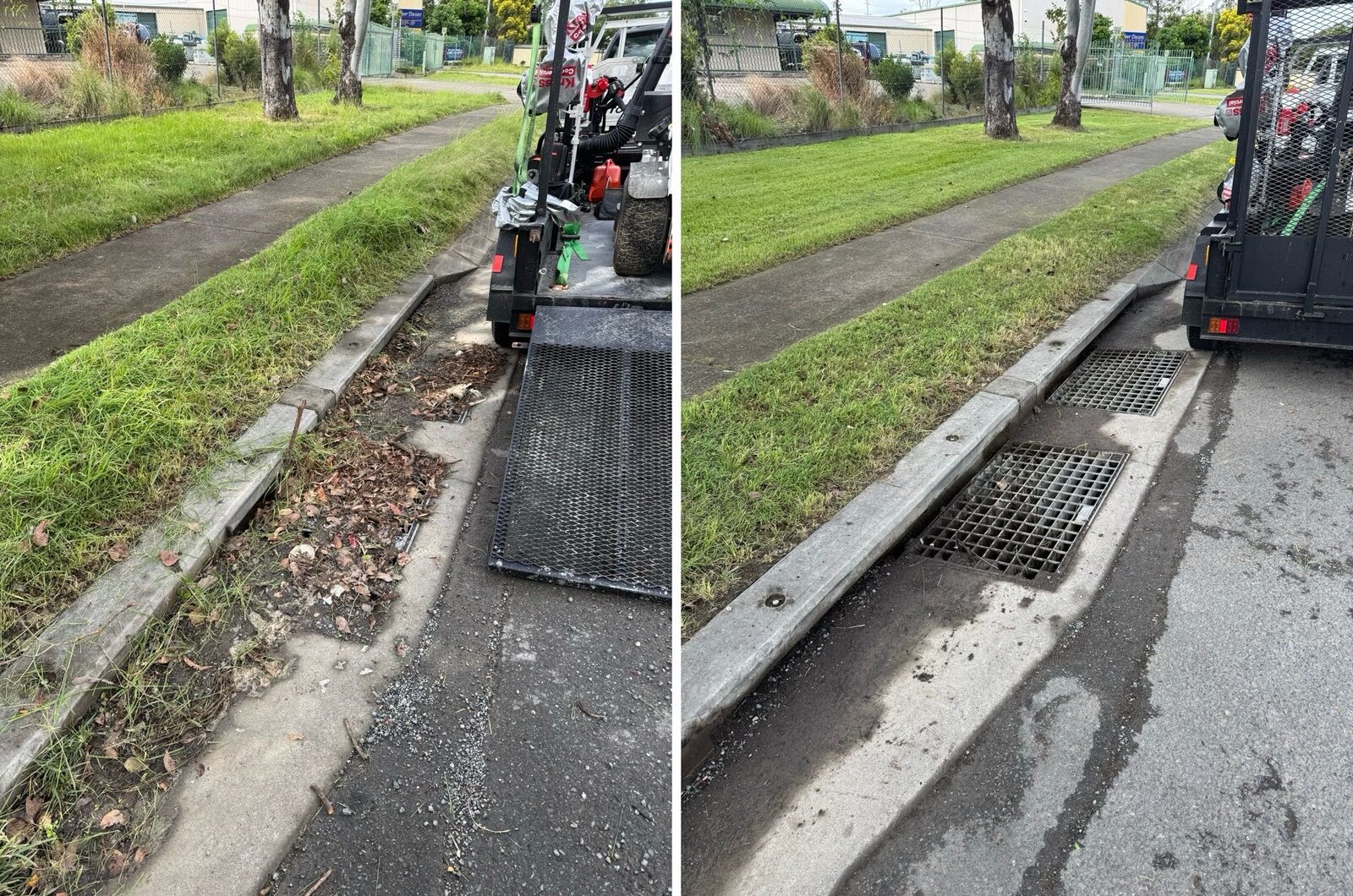 The kerb channel and stormwater grate cleared. Buried grates are one of the more consequential results of deferred grounds work, and they only announce themselves in heavy rain.
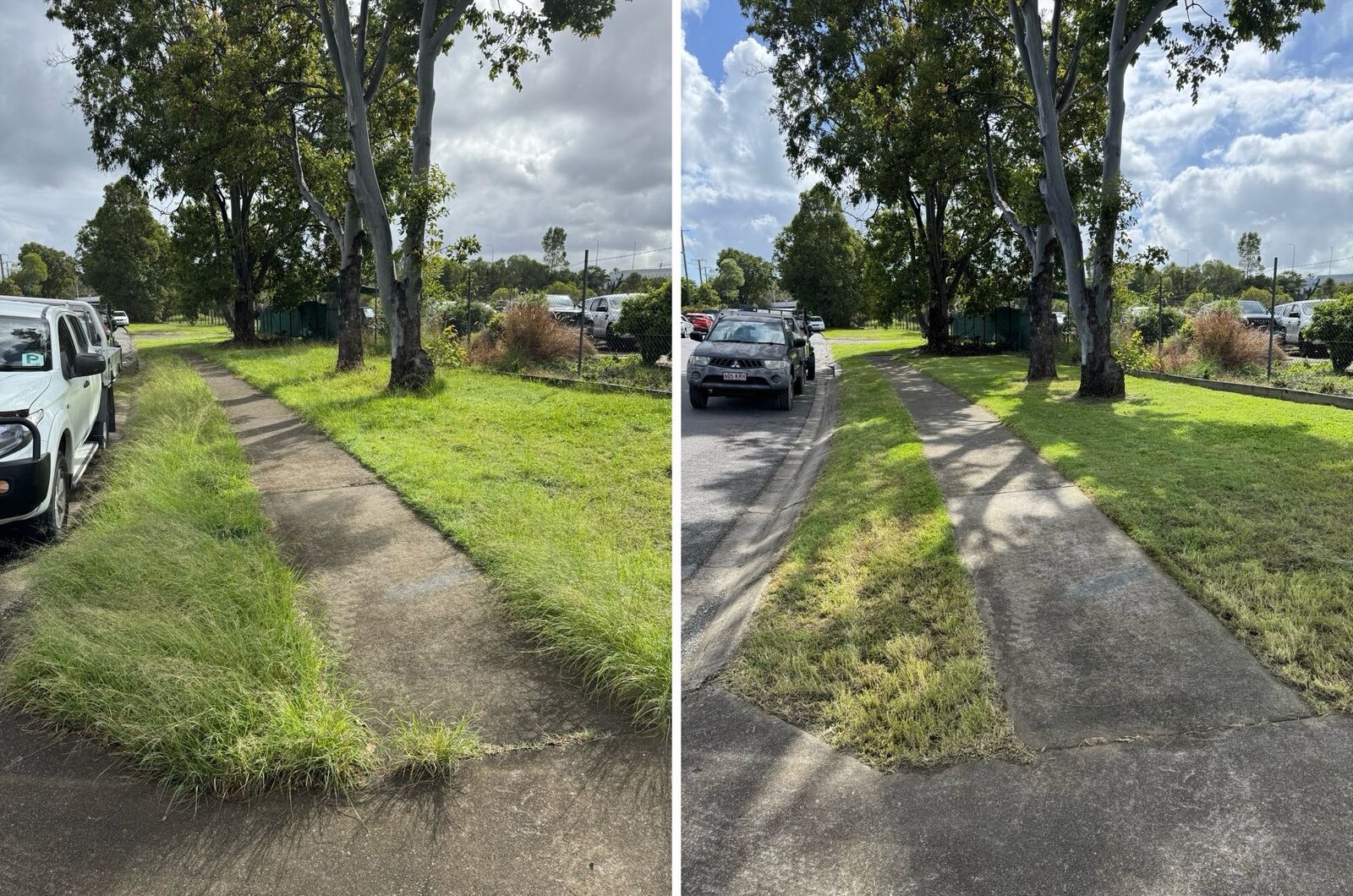 Tussocky growth cut back off the footpath and the verge brought to an even height.
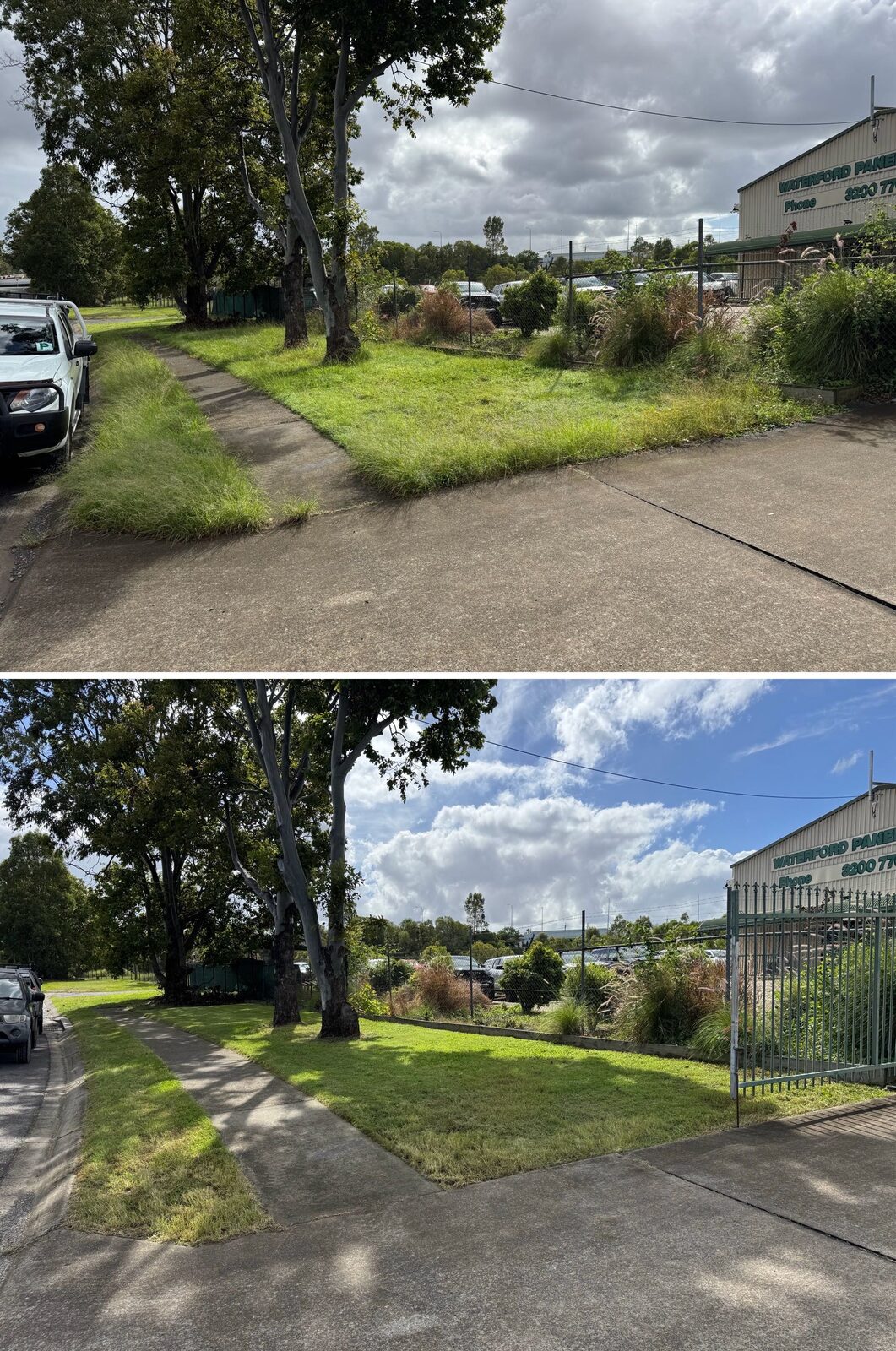 The frontage and the strip inside the fence line, cleared and cut back to a defined edge.
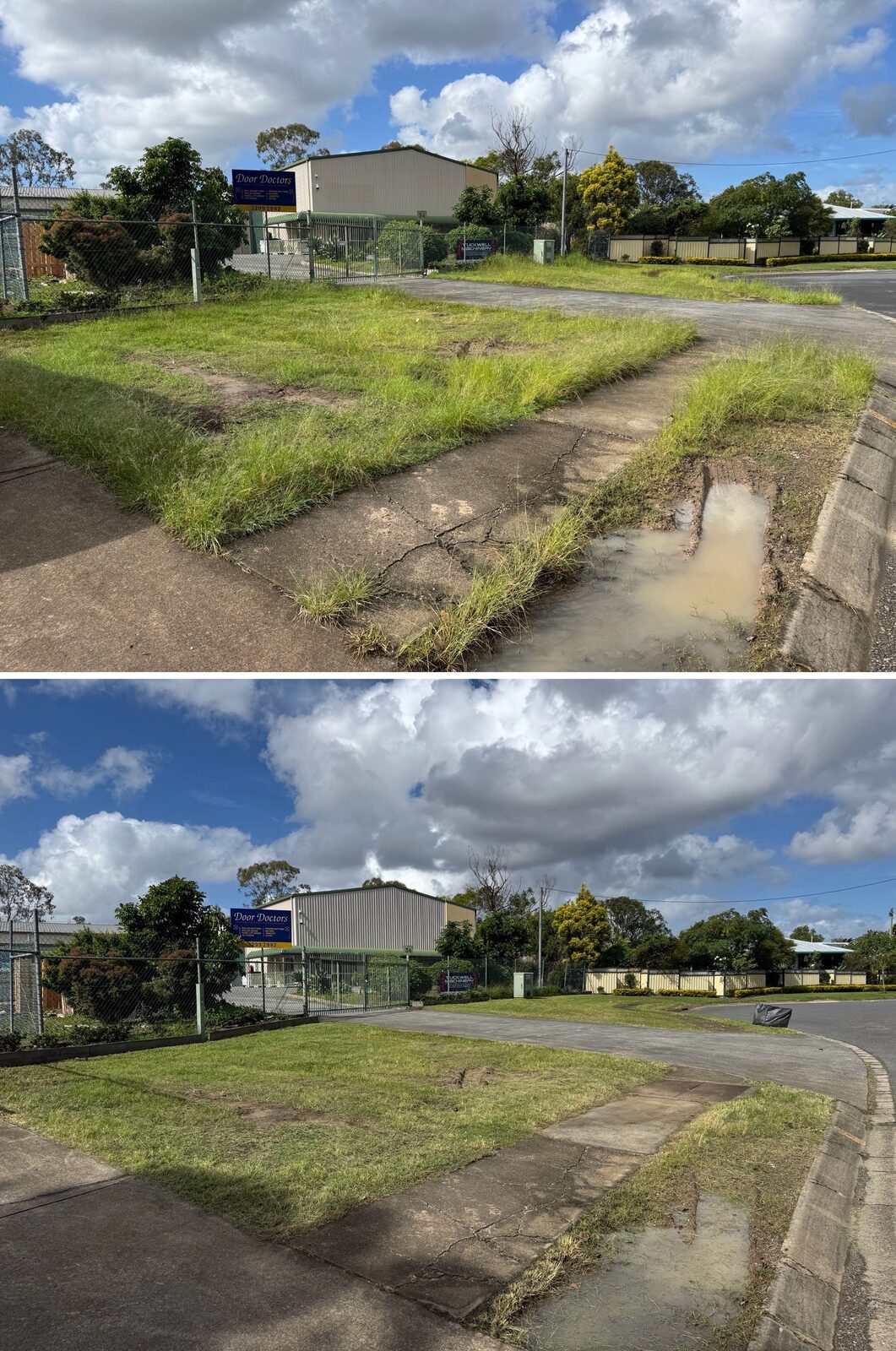 The driveway crossover and entry apron, with growth cleared out of the cracks and joints.
That first visit was a reset. Everything since has been routine, because monthly visits mean there is never more than a month of growth to deal with. The site has not needed another clean-up, and it will not, as long as the schedule holds.
That is the whole argument in one property: pay once to reset, then pay a small regular amount to never reset again.
Budgeting for it
Two practical points.
Separate the reset from the schedule. If your site has already drifted, the first visit is a different job from the ongoing ones and should be quoted separately. A contractor who quotes you an ongoing rate that quietly absorbs a large clean-up is either going to lose money or cut the clean-up short.
Do not buy an annual number. Ask for a per-visit rate and a frequency, so you can see what you are actually paying for and adjust the frequency by season. An annual figure hides whether you are getting 12 visits or 20.
Wet season
One seasonal note specific to this part of the country. Through the summer wet, two things happen at once: growth accelerates sharply, and access to soft ground gets difficult.
A schedule that ignores this fails predictably every January. If your site has areas that get boggy, that needs to be part of the conversation up front, because the answer is sometimes to bring the visit forward rather than push it back.
Setting a schedule for your site
If you are responsible for a commercial or industrial property in Logan, the sequence is:
- Work out whether the site needs a reset first, or just a schedule
- Split the site by exposure, so the frontage and the back yard are not on the same cycle
- Set a warm season frequency and a winter frequency rather than one interval
- Handle hedges and beds separately from mowing
- Agree what happens in the wet
We will do that assessment as part of quoting. See our scheduled grounds maintenance contracts, or ask us for a quote and we will tell you plainly whether your site needs a clean-up before a schedule makes sense.
For the areas we cover, see grounds maintenance across Logan's industrial precincts.
Professional Garden Care Services
Need expert help implementing these techniques? EcoMow Sustainable Gardening provides professional services in Loganlea and surrounding areas.